
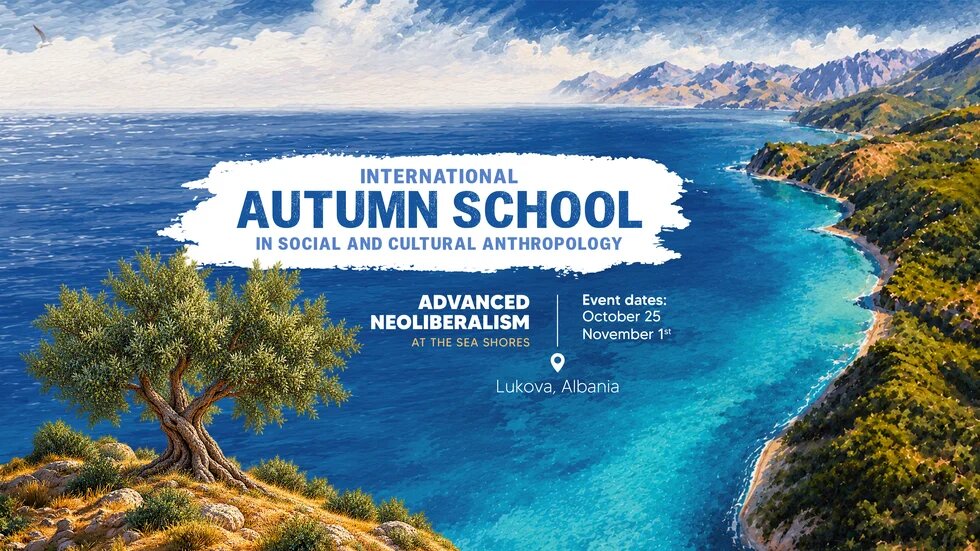
Topic: Advanced Neoliberalism at the Sea Shores
Location: Lukova, Albania
Dates: 25.10-01.11 2026
Introduction
How do tourism, capital flows and real estate development reshape communities, identities and everyday life in the context of advanced neoliberalism? What happens when villages become investment assets, landscapes become commodities, and homes become financial products? How are migration, memory and belonging transformed in an age of global mobility?
The 3rd International Autumn School in Social and Cultural Anthropology invites students, researchers, artists, activists, and practitioners to explore these questions during an intensive week of lectures, collective readings, discussions, field excursions, and conversations with local communities in Lukova, a traditional village on Albania's southern Ionian coast.
Applications are now open. Apply here.
Why Lukova?
Situated between centuries-old olive terraces, mountains, and the Ionian Sea, Lukova provides a unique setting to explore the intertwined relationships between memory, cultural heritage, landscape, and social change. The region's rapid transformation – driven by multiple migration waves, touristification, real estate development, and the financialization of land and property – offers an exceptional opportunity to examine how local communities negotiate continuity and change, redefine belonging, and respond to evolving configurations of economic and political power.
Program and methodology
The Autumn School is designed as a balanced combination of theoretical learning and field-based experience.
Morning sessions are dedicated to:
- Common readings and guided discussions
- Lectures on key theoretical frameworks
- Collective reflection on concepts and methodologies
Afternoon sessions focus on:
- Field visits in Lukova and surrounding areas
- Interviews with local residents and stakeholders
- Excursions and site-based lectures
- Ethnographic observation and documentation
This structure creates a continuous dialogue between theory and practice, allowing participants to apply conceptual tools directly to empirical observations and collaboratively reflect on their findings.
This year's edition focuses on the following themes:
- Critical theory, neoliberalism and advanced neoliberalism
- Cultural and social anthropology of the Mediterranean
- Migration and diasporas
- Touristification and the political economy of natural and cultural heritage
- Financialization, property and real Estate
- Commons, collective Memory and social reproduction
- Old and new customary law and local institutions
Who should apply?
The school welcomes Master's students, PhD candidates, researchers, artists, activists and professionals working in anthropology, sociology, geography, political science, architecture, urban studies, philosophy, cultural studies, and related disciplines. Previous fieldwork experience is not required; however, applicants should demonstrate a strong interest in ethnographic research, interdisciplinary dialogue and collaborative learning.
Application timeline
Application opens: 24 August 2026
Application deadline: 13 September 2026
Notification of selected participants: 21 September 2026
Complete the online application form here.
Practical information
The School will take place in Lukova, Albania. The working language of the programme is English. Participants will be provided with accommodation in Lukova, meals included in the programme, local transportation throughout the School, and return bus transportation between Tirana and Lukovë.
Any additional travel, accommodation, meals, or personal expenses outside the programme are the responsibility of the participants. Limited travel-related financial support for participants from the region may be available based on individual need and subject to available budget.
Participants are expected to attend the full programme, actively engage in seminars and fieldwork activities, and contribute to the collaborative learning environment.
About the organizers
Heinrich Böll Stiftung Tirana is the Tirana office of the German Green Political Foundation under the same name. Its work focuses on democracy, ecology, social justice, and gender equality.
The House of Anthropology - Centre for Research in Social and Cultural Anthropology (QSASK) is an independent research centre dedicated to advancing anthropological knowledge through field-based research, academic collaboration, and public engagement.
Follow the School and its organizers for updates, publications, and behind-the-scenes insights from the field.
International Seasonal School in Social and Cultural Anthropology (ISSSCA) | Email: isssca.al@gmail.com