
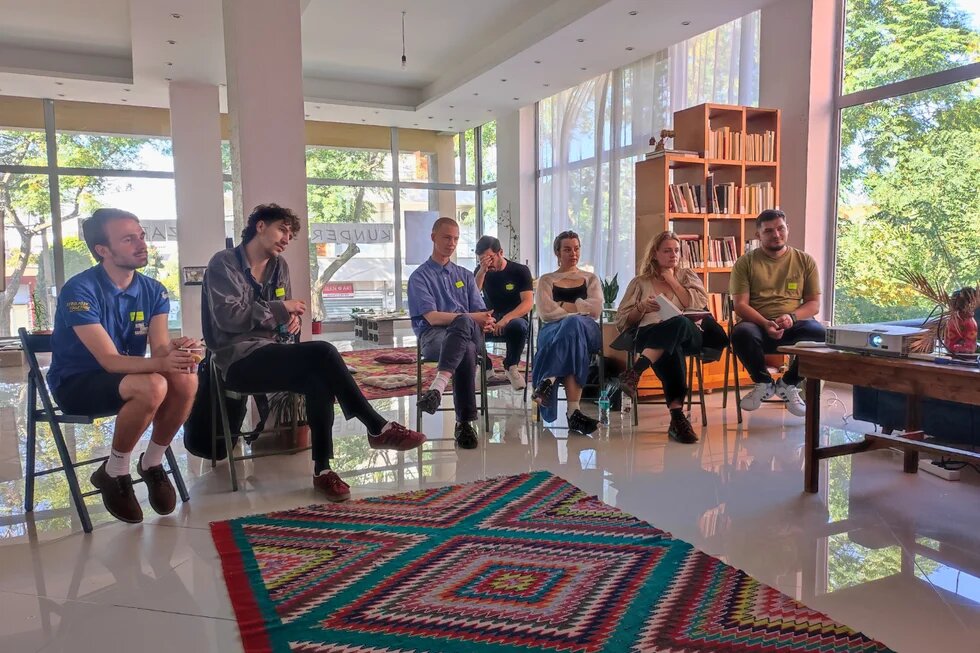
It has been more than four months since I took part in the workshop Reading the Peripheries as part of the Congress of Young Europeans 2025, hosted by the local office of the Heinrich Böll Stiftung in Tirana. Since then, time has passed for the experience to detach itself from the hectic pace of the congress and return as a sequence of scenes, encounters, observations, and moments of reflection that together continuously form an image of Kamza I had not expected beforehand.
On the road to Kamza
It was the second intense day of the congress when our group boarded the bus heading north. We left city centre behind us, which slowly dissolved into a different and seemingly improvised urban fabric, without us being able to clearly indicate the line, which separates the Municipality of Tirana and the Municipality of Kamza. On the bus, the atmosphere was exuberant: informal exchanges about panels, jokes, speculations, a certain euphoria of being temporarily suspended from the conference routine.
A First Encounter: Grupi ATA
The building hosting Grupi ATA - which translates to “them”- a local activist collective, looked quite unremarkable from the outside and was located in a side street of the busy and heavily congested main road. We entered the building and on the first floor, a generous, open space welcomed us: light-filled, carefully and lovely arranged. Chairs arranged in a loose circle, snacks and coffee. The shelves holding theory volumes and activist publications in Albanian, alongside the printed edition of nyje.al, the local, community newspaper for the municipality of Kamza. The room felt like a hybrid between a studio, archive and neighborhood center.
How Kamza became a "periphery"
The Municipality of Kamza is located in Tirana's northern metropolitan area and until the fall of communism in the early 1990s, was a small village. Diana Malaj - a local researcher, activist and lawyer - guided us through Kamza’s subsequent post-socialist formation, with special focus on Bathore, one of the earliest and most emblematic post-1990 “informal” settlements. The narrative she adopted was not of chaos, but of structuring forces: rural-to-urban migration after the fall of state socialism, the vacuum of the early transition, unregulated land claims, community ties based on customary law and the contradictory presence of the state, absent where support was needed, present only where control or demolition were at stake.
These neighborhoods were rapidly labelled informal, often paired illegal. But as the workshop emphasized, this label adopted by architects, policymakers and academics is not neutral. It (re)produces and stabilizes the “periphery.” It marks Kamza not as an urban alternative, but rather as a deviation, a deficiency, a space to be tolerated yet disavowed.
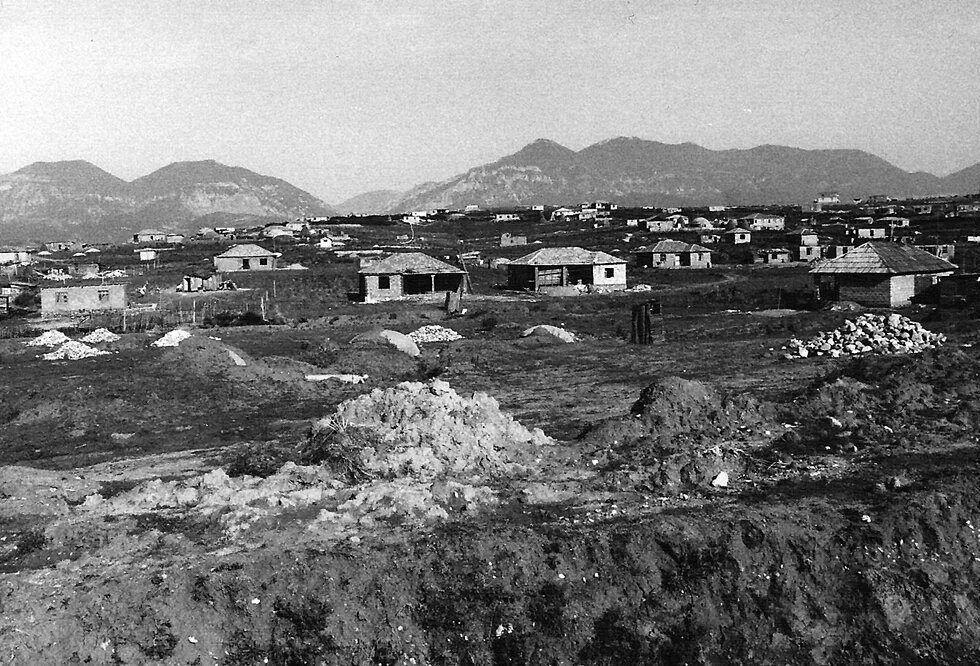
Following the theory of Ananya Roy, a prominent urban studies scholar, informality here emerges not as the absence of planning, beyond the dichotomy of formal – informal, but as a tool of urban governance. Legality in this case is selectively applied; tolerance and repression oscillate according to political needs. The politics of the bulldozer is only the most visible manifestation of this selective sovereignty. Kamza becomes an “anomaly” not because it is inherently so, but because its designation as such legitimizes marginalization.
This process of “othering” similarly becomes visible through persistent discursive stigmatization. Whether this is the reluctance of a taxi driver to get you from Tirana to Bathore, a joke about having to acquire a "Kamza-Passport" when entering the municipality - commonly used and suggesting that Kamza is so different that it requires special permission, as if it were a foreign country - or the use of derogatory terms for its residents. These examples illustrate everyday perpetuations of Kamza's stigma, sometimes openly hostile, sometimes in ironic self-consciousness, which the activist collective Grupi ATA resists and wants to re-narrate.
Exhausting Kamza: Observations from the rooftop
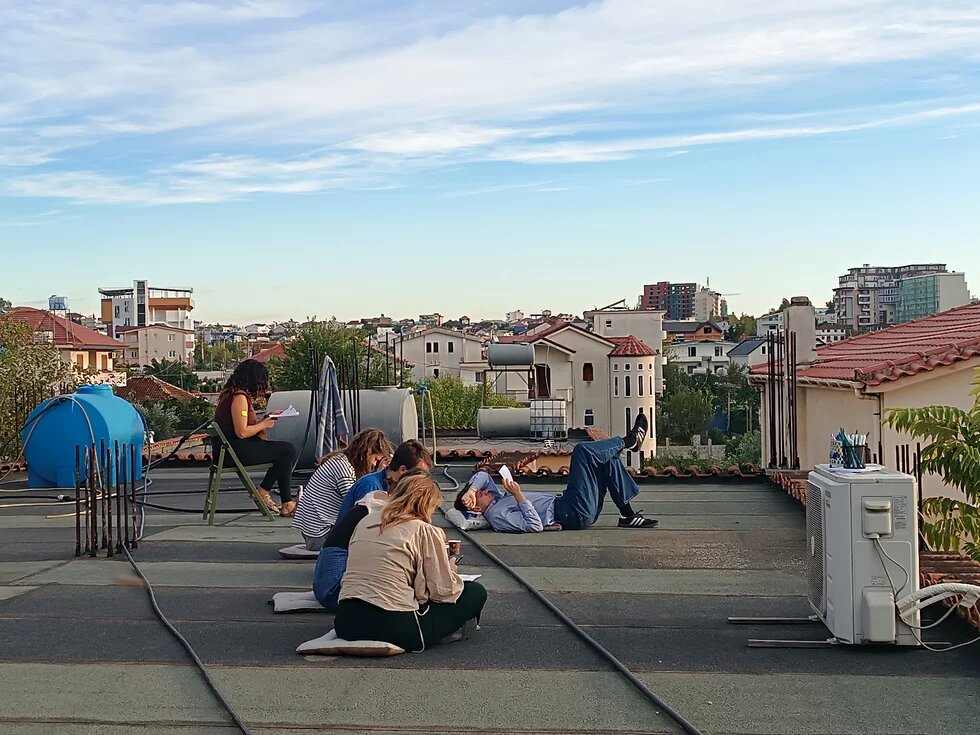
After the input session, which was enriched by continuous questions by the participants, we stepped outside to the rooftop of the ATA centre. As part of an observational exercise inspired by Georges Perec, an influential French writer and filmmaker, whose Attempt at Exhausting a Place in Paris (1) follows the trivial, the repetitive, the overlooked, we decided to sit down, observe, write, and attend to what was not part of any official narrative of Kamza.
I noted:
The sun was lowering in the west when I stepped out of the first floor of the building, warming my face while the road below remained busy and noisy. A colder breeze rushed past my arms. An unexpected contrast that made me suddenly aware of my own temperature. This feeling made me wonder how natural sun light shapes the everyday life of people living in the surrounding buildings, how light travels through the rooms, how it dictates daily rhythms.
Inside, during the workshop, we struggled with the brightness of the space: it was too well-lit to provide enough contrast for the projector. Windows on the first floor opened both toward the street in the north and toward the east, probably bathing the room in pleasant light in the morning. The toilet of the building, by contrast, lay in a narrow passage without natural light, forcing you to switch on the lamp just to wash your hands or see your face in the mirror. These small spatial transitions, from bright openness to sudden enclosure, felt strangely intimate, reflecting the building’s architectural (improvised) logics.
Looking outward I observed, that the windows across the surrounding neighborhood appeared in every possible size and shape. Some were tucked awkwardly under saddle roofs, forming diverse geometries. Others reflected the afternoon sun so intensely that looking at them felt like staring back into the sun. In the dense fabric of Kamza, every window seemed engaged in a subtle competition for light. Each apartment claimed its share of this “ingredient” necessary for daily life.
Some of the taller buildings were oriented deliberately north–south, as if tilting their faces toward where they could catch the most brightness. Others, still under construction, stood as hollow concrete skeletons, casting long, geometric shadows across the plots. In the light, these incomplete structures resembled X-ray images of buildings still becoming themselves.
I found myself standing roughly at the same spot where I had stepped outside earlier, but the warmth on my face was gone. The contrast I had noticed then - between sun light and breeze - had quietly resolved into a uniform coolness. The sun light, now dimmed behind a veil of clouds, was softening into dusk, and across Kamza, one by one, artificial lights began to take over.
Final reflections
This experience of sitting, watching, and noting observations of my surroundings shifted my perspective. Light, reflections, silhouettes of incomplete buildings, the quiet logic of window placement, none of these appear in the usual narratives about Kamza. Yet they reveal something essential about the everyday life to inhabit space in a dense urban environment. Through them, the city’s improvisation becomes visible not as disorder but as a practice of adaptation, small, ordinary strategies for claiming presence.
Additionally, the insights of the workshop helped me to further understand Tirana’s current urban developments in the light of Europeanization. Kamza, in political and academic discourse, is continuously portrayed as Tirana’s constitutive other, an underdeveloped part of Tirana’s metropolitan area, in order to construct and reify a polished, “European” and “Westernized” image of the city. Against this backdrop, Kamza becomes not only a place of exclusion but a crucial site from which to rethink how urban “Europeanness” is narrated, who gets included in its image, and who is persistently left out.
Footnotes
- 1
Hawkins, J.A., 2024. Exhausting Urban Places …à la Georges Perec, in: Moura, C.M. e, Bernal, D.M., Restrepo, E.R., Havik, K., Niculae, L. (Eds.), Repository: 49 Methods and Assignments for Writing Urban Places. pp. 78–81