
Article
Reflecting on Europe’s "ends" is both a geographical and philosophical question. It requires reflecting on the ethical, ecological, and political foundations of the European project itself. At a moment marked by war, democratic regression, and environmental breakdown, this question becomes less about geography and more about responsibility. The Congress of Young Europeans 2025 aimed to create a space for this reflection.
Opening in a public space
Rather than a closed institutional setting, the Congress opened in Skanderbeg Square, a space where Ottoman history, socialist memory, and post-communist transformations intersect. The choice of location positioned the congress within the very tensions it sought to examine.
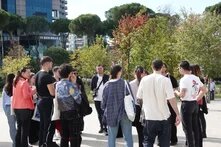
CYE participants gathered at Skanderbeg Square
Image credits
CYE participants gathered at Skanderbeg Square
Image credits
CYE participants gathered at Skanderbeg Square
Image credits
CYE participants gathered at Skanderbeg Square
Image creditsParticipants gathered in the Temporary Pavilion; an open cultural space created by hbs Tirana Office in response to the shrinking public space in the city. As both a venue and a statement, the Pavilion framed the congress as a reflection on access, participation, and who has the right to shape public life.The Pavilion hosted the photography exhibition "Don’t Look Back at the Burning House", by Jutta Benzenberg capturing everyday life in Albania during the turbulent decade of the 1990s. The images served as a visual reminder that Europe’s past and uncertainty are not distant, but continue to shape the present.
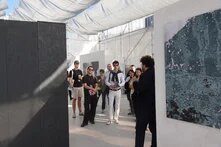
CYE Participants inside the Temporary Pavilion & Exhibition
Image credits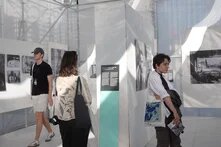
CYE Participants inside the Temporary Pavilion & Exhibition
Image credits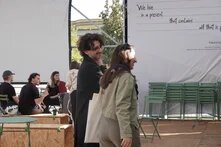
CYE Participants inside the Temporary Pavilion & Exhibition
Image creditsThe opening day concluded at Tirana’s historic Puppet Theatre with the screening of a documentary on the life and work of Petra Kelly - a peace activist, environmentalist, feminist, and co-founder of the German Green Party. By revisiting her legacy, the screening anchored the congress in a longer trajectory of European activism. Kelly’s political vision, rooted in ecological responsibility and non-violent activism, provided an inspiring starting point: what forms of political action remain possible today, and where do they take place?
Debating Europe’s current crises
The Congress combined voices from politics, civil society, academia, and grassroots activism, highlighting the tensions between Europe’s proclaimed values and its political realities. Rather than relying solely on formal panels, the program structure combined debates with workshops, cultural activities, and encounters with local communities.
Europe between normative power and political reality
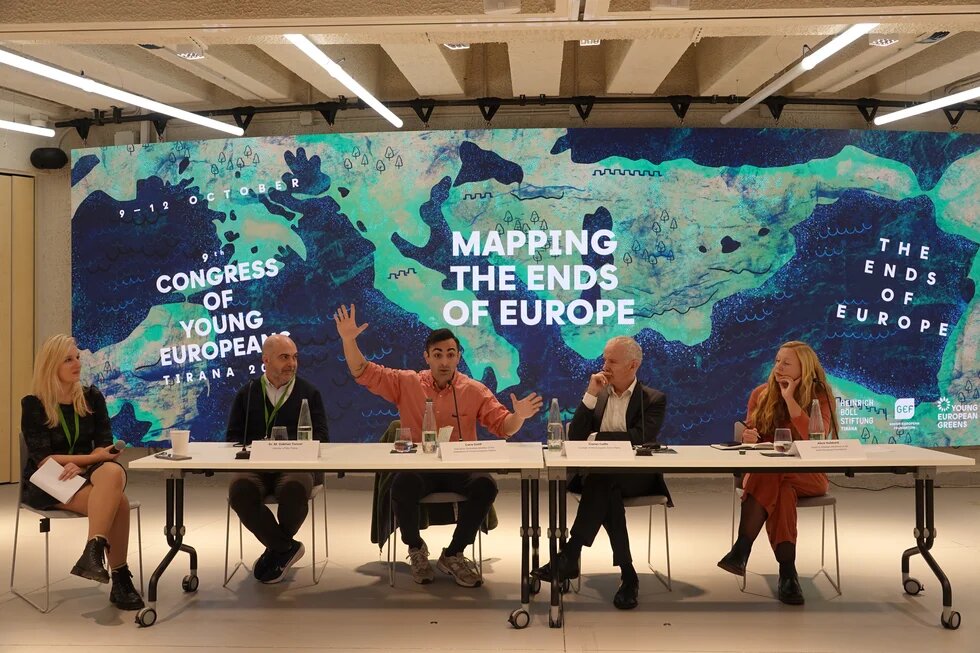
The opening panel, moderated by Evi Veliu, invited the participants to explore how Europe acts under pressure. Contributions from Ciarán Cuffe (Irish Green Party politician and former MEP, 2019–2024), alongside Luca Guidi, Alice Hubbard, and Dr. Gökhan Tuncer, pointed to a growing dissonance: Europe continues to present itself as a normative power, yet struggles to uphold those norms both internally and externally.
Across the discussion, a distinct green perspective emerged - linking democratic resilience, social justice, and ecological transformation. From the experience of European-level policymaking to the engagement of young participants, the exchanges reflected a shared concern: that Europe’s credibility as a political project depends not only on the values it promotes, but on its capacity to translate them into consistent action.
In his video message, Jan Philip Albrecht, Co-President of Heinrich Böll Stiftung, stressed that the question is not just about Europe as it is today, but about the Europe we choose to build. A Europe that champions “human rights, democracy, and a socially and environmentally sustainable future.” The discussion made clear that Europe is not a static entity. It is an ongoing political project, constantly shaped by decisions, compromises, and participation.
Nature at Europe’s edges
The second panel, moderated by Tea Zeqaj, shifted the focus from territorial limits to ecological ones. This session explored how environmental crises are transforming the landscapes and political priorities across the continent. Contributions from Vedran Horvat, Dr. Sofie Ruysschaert, and Jovana Janjušević highlighted the urgent challenges of biodiversity loss and habitat fragmentation in the region. The Balkans, as one of Europe’s most significant biodiversity hotspots, illustrate how conservation efforts are threatened by infrastructure development, hydropower projects, and unsustainable economic policies.
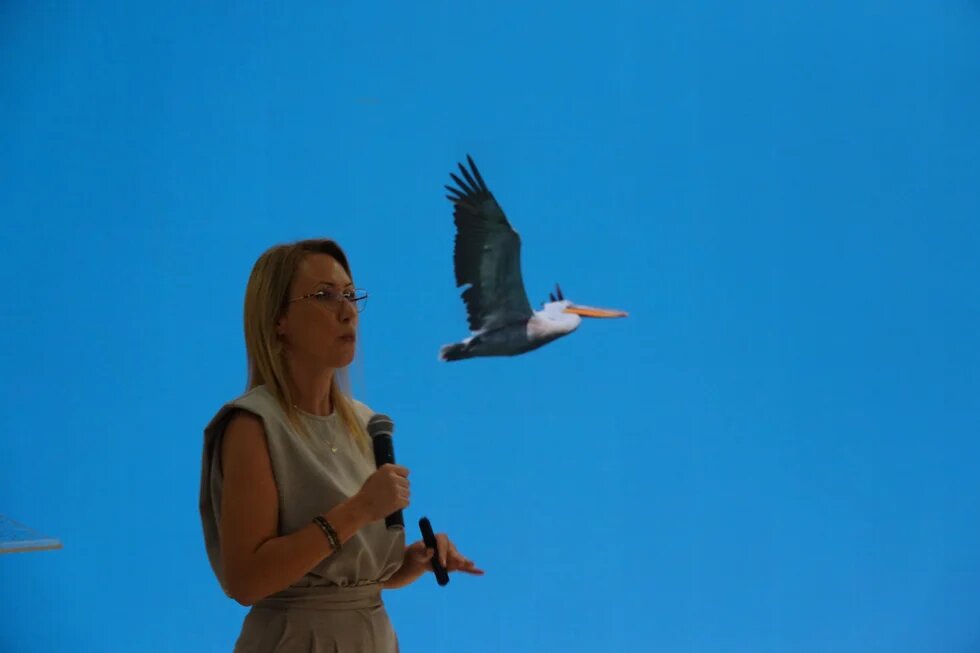
What emerged here is that environmental protection is not only a scientific or policy question, but also a political one. The future of Europe’s ecosystems depends on important collective decisions about development, conservation, and social justice.
Grassroots environmental movements
In Albania, grassroots movements have increasingly mobilized to defend rivers, forests, and protected areas from large-scale infrastructure projects. In her presentation, the researcher Diana Malaj, brought the case of Zall-Gjoçaj, within the Lurë-Mali i Dejës National Park, where the local communities combined protest, legal action, and cultural resistance (artistic interventions, such as theatre, exhibitions, presentations) to oppose hydropower development. These struggles show that environmental protection is not only about conservation, but also about decision-making over shared resources.
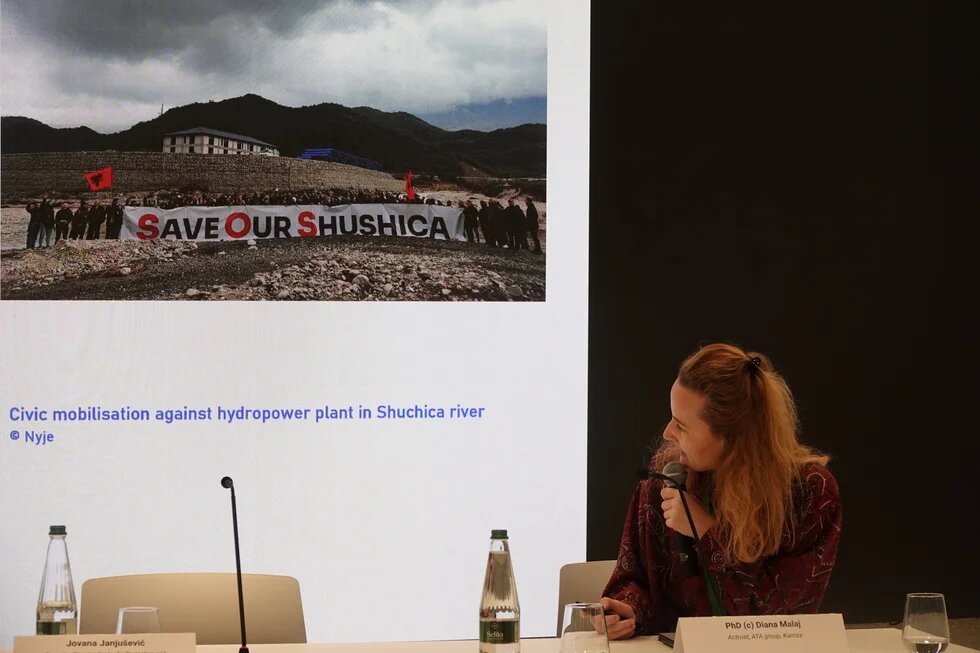
Across the region, from the decade-long struggle to protect the Ulcinj Salina in Montenegro to the defense of the Vjosa River, such movements show that European "green" goals must not come at the expense of local sovereignty or the commodification of nature.
Gender at the margins
The third panel, moderated by Edona Bylykbashi, focused on another "edge", where questions of gender, identity and power intersect. Contributions from Dr. Suzana Milevska, Assoc. Prof. Linda Gusia, and Assoc. Prof. Ermira Danaj examined how gender relations are shaped by historical trauma, nationalism, and economic transformation in the Balkans.
Dr. Milevska reflected on the contradictions within feminist movements in the Balkans and the rise of anti-gender mobilizations. Drawing on an ecofeminist perspective, she discussed how political and cultural interpretations of feminism sometimes reproduce patriarchal structures, the very hierarchies it seeks to challenge under contemporary neoliberal conditions.
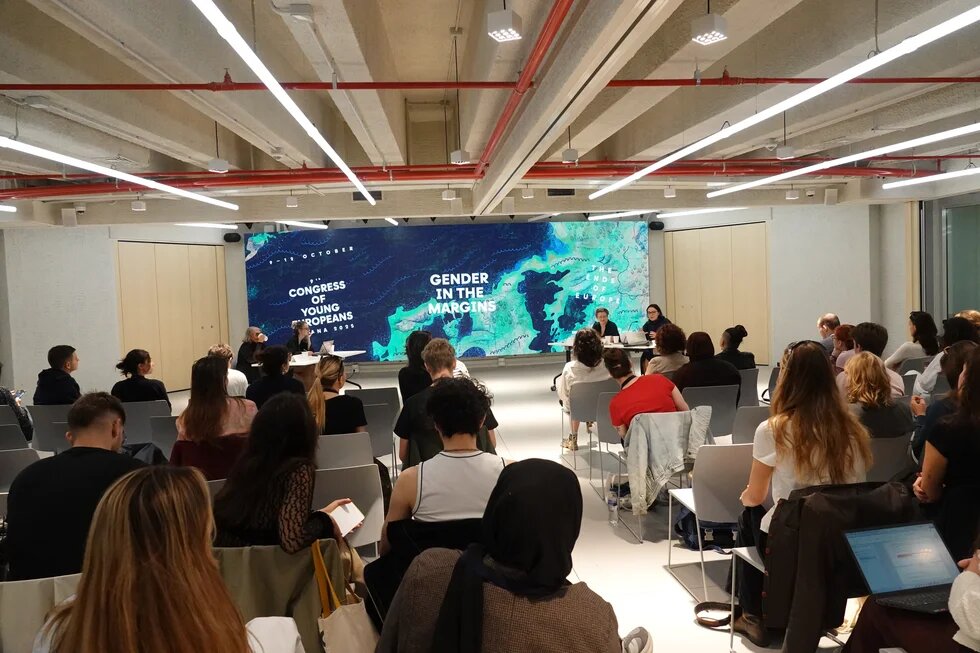
Assoc. Prof. Danaj focused on the role of masculinity in nationalist politics across the Western Balkans. Her presentation highlighted how dominant models of masculinity continue to frame men as protectors of the nation, family, and tradition. Such narratives often reinforce gender inequalities and fuel hostility toward LGBTIQ communities.
These discussions showed how debates on gender equality are closely linked to broader struggles over democracy, belonging, and political power in Europe today. In this sense, Europe’s “ends” are not only geographical. They also emerge from within, through tensions that define who is included, represented, or excluded.
Migration and Europe’s Shifting Borders
Nowhere is the question of Europe’s "ends" more concrete than in migration policy.
The fourth panel, moderated by Chrysiis Katsea, examined how technological surveillance systems, deterrence policies and border violence are reshaping the experiences of migrants across Europe. Contributions from Tineke Strik, Giorgia Jana Pintus traced a clear shift: Europe is increasingly redefining its borders not by extending them, but by outsourcing them.
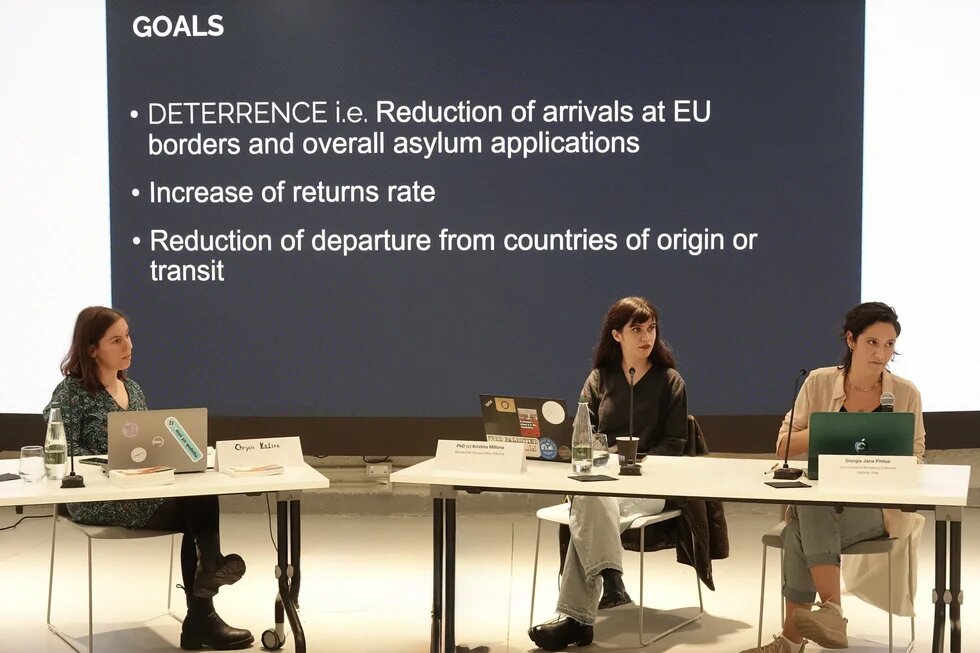
Drawing on the case of Italy–Albania migration agreement of 2023, the researcher Kristina Millona highlighted what this shift means in practice. Asylum procedures are relocated, responsibility becomes blurred, and legal protections risk becoming harder to access. The relocation of asylum procedures outside EU territory raises legal and ethical questions. When migration management is outsourced to countries beyond EU borders, who remains responsible for protecting asylum seekers? What happens to the right to asylum when legal procedures are geographically displaced?
In this context, Europe’s "end" appears not as a fixed boundary line, but as a mechanism: a mechanism that selectively includes, excludes, or shifts responsibility depending on political priorities.
Workshops and collaborative learning
The congress also featured workshops shifting the focus from discussion to practical and concrete engagement. Participants worked together to develop ideas and recommendations addressing some of Europe’s most pressing challenges.
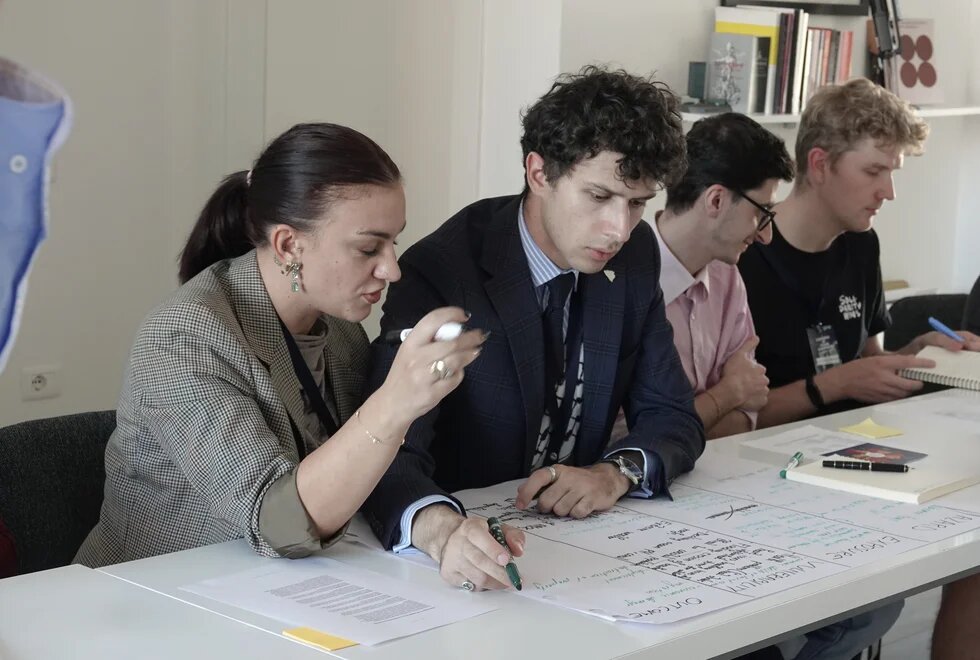
Sessions examined topics ranging from anti-gender movements and LGBTQ+ activism to energy democracy, creative civic activism, and youth engagement in peace and climate security. They underscored a key point: Europe’s future will not be determined solely at the level of institutions, but through dispersed practices of political participation.
A congress that moved through the city
One of the most distinctive elements of the Congress was the urban walking tours. Participants moved beyond formal settings to explore Tirana through guided walks led by local activists and researchers.
In neighborhoods shaped by rapid development, participants encountered the material consequences of policy decisions on housing, public space, and inequality. In Kamza, a city on the periphery of Tirana, questions of marginalization and the right to the city became tangible. Around the Artificial Lake, discussions on biodiversity connected ecological concerns to everyday life.
By walking through the city, observing, and listening to local stories of activism and resistance, participants encountered Europe’s challenges not as abstract policy debates but as lived realities. These encounters offered a different perspective on Europe’s “ends”, not as abstract dilemmas, but as lived conditions.
Tirana at the margins or at a vantage point?
Holding the congress in Tirana added another symbolic layer. The Western Balkans are often framed in European political discourse as a periphery, waiting at the gates of the European Union. Yet such narratives ignore the region’s deep historical and cultural entanglements with the rest of the continent.
Seen from Tirana, the perspective shifts. The boundaries of Europe appear less rigid and more open to reinterpretation; its internal contradictions become more visible. What is often considered a "periphery" can be a vantage point, from which the coherence of the European project becomes easier to question and reflect upon.
From Tirana, Europe appears less as a fixed center with clear margins, and more as a project in the making.
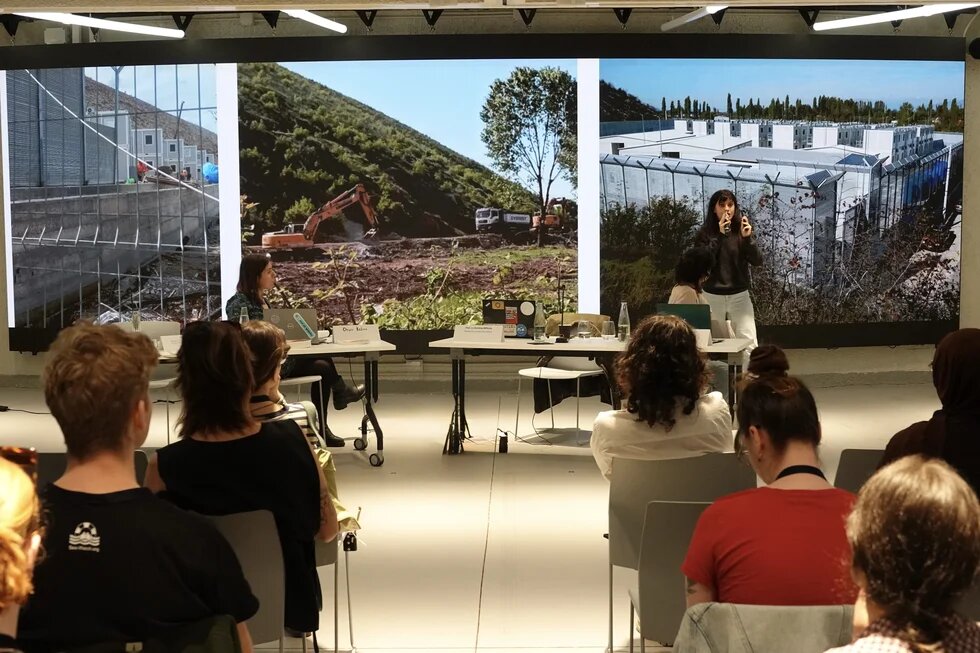
From the panels on biodiversity, gender, and migration to the streets of Tirana, participants encountered Europe in motion, as a dynamic and contested space, shaped by both political decisions, social struggles, and everyday practices. The Congress highlighted how boundaries - geographical, social, and political - are continuously drawn and redrawn through debate, activism, and collective engagement. Rather than offering fixed conclusions, it created a space to reflect, question, and connect across differences.
What remains from Tirana is a set of ongoing conversations that extend beyond the sessions, connections that span borders, and ideas that continue to evolve. Each future gathering will bring new topics, perspectives, and contexts, building on what has been explored while opening space for new questions and encounters.
Thus, the Congress continues to be a living experiment, a platform for young Europeans to explore emerging challenges, exchange experiences, and contribute to the debates that shape the continent. The reflections from Tirana will carry forward, not as conclusions, but as invitations to engage, to listen, to explore, and to imagine what comes next, inviting the future congresses to continue this collaborative journey of discovery, dialogue, and action.